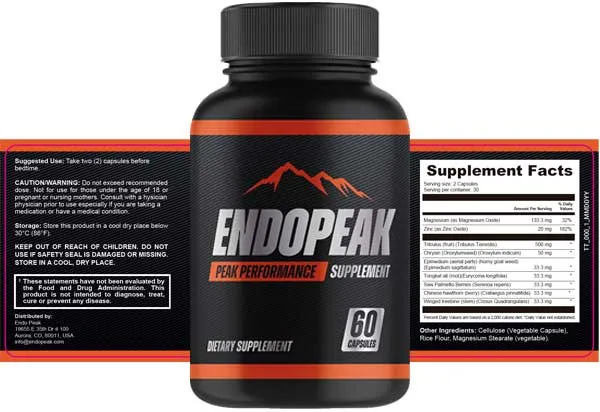
Formula overview
EndoPeak's current two-capsule serving contains two minerals and seven botanicals. Marketing language commonly groups some botanicals around male vitality or performance, but the label itself does not establish clinical outcomes.
Complete ingredient list and amounts
Magnesium oxide · research guide
Zinc oxide · research guide
Tribulus terrestris · research guide
Oroxylum indicum · research guide
Epimedium sagittatum · research guide
Eurycoma longifolia · research guide
Serenoa repens · research guide
Crataegus pinnatifida · research guide
Cissus quadrangularis · research guide
Magnesium and zinc
Magnesium contributes to many normal biochemical processes, including muscle and nerve function. Zinc is involved in numerous enzymes and biological processes. Those established nutrient roles should not be stretched into a claim that EndoPeak treats sexual dysfunction or raises testosterone in every user. The specific forms listed are magnesium oxide and zinc oxide.
Seven botanical ingredients
Tribulus terrestris — 500 mg
Tribulus is common in male-performance supplements. Human trials and reviews have produced mixed findings depending on population and outcome. A study of an ingredient is not a study of the complete EndoPeak formula.
Chrysin — 50 mg
Chrysin is a flavonoid often marketed in hormone-support contexts. Human pharmacokinetic research has reported low oral bioavailability, and a small human study did not find a change in urinary testosterone with a chrysin-containing preparation. That makes strong testosterone-boosting promises especially inappropriate.
Epimedium — 33.3 mg
Epimedium species contain compounds including icariin that have been studied in laboratory, animal and limited human contexts. Reviews discuss biological mechanisms, but mechanism-level research does not establish that EndoPeak has a clinical erectile-function effect.
Tongkat Ali — 33.3 mg
Tongkat Ali has human studies and meta-analyses in selected populations. Products, extracts and doses differ, however, so findings cannot simply be transferred to this formula.
Saw Palmetto — 33.3 mg
Saw palmetto has been studied extensively for urinary/prostate symptoms. NCCIH notes that saw palmetto alone is probably not helpful for symptoms of benign prostatic hyperplasia and that evidence for other uses is insufficient.
Chinese Hawthorn — 33.3 mg
Hawthorn has a history of use in cardiovascular contexts, but NCCIH emphasizes limitations in the evidence and notes possible adverse effects and interactions.
Winged Treebine / Cissus quadrangularis — 33.3 mg
Cissus quadrangularis has been studied for several possible uses. Systematic reviews emphasize the need to interpret small, heterogeneous studies carefully.
What ingredient evidence can and cannot tell us
References
- NIH ODS — Magnesium
- NIH ODS — Zinc
- NCCIH — Saw Palmetto
- NCCIH — Hawthorn
- Tribulus systematic review — PubMed-indexed review.
- Tongkat Ali meta-analysis — PubMed-indexed meta-analysis.
- Chrysin disposition in humans — Human pharmacokinetic research.
- Cissus quadrangularis systematic review — PubMed-indexed systematic review.
- Epimedium/icariin review — Mechanistic and clinical-context review.